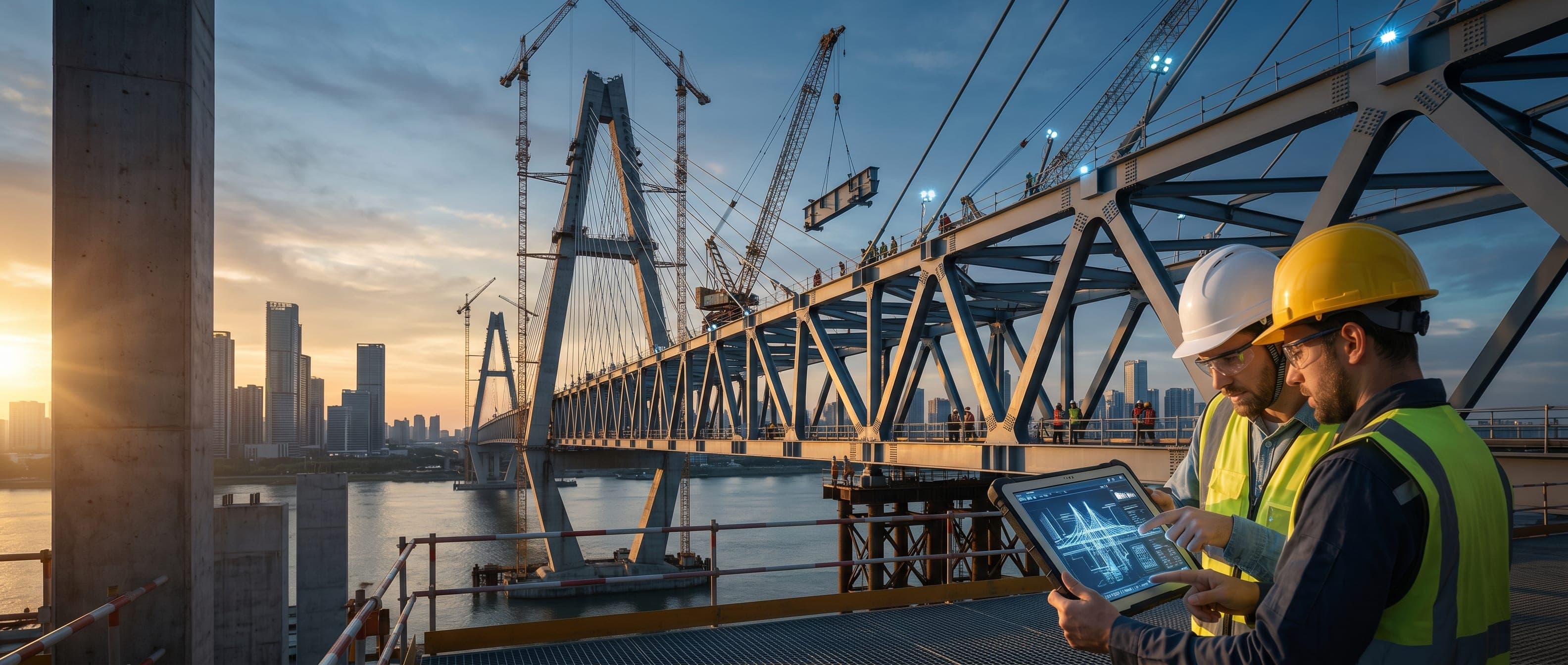
The skyline of Indian infrastructure is evolving. Signature projects—from sea-link bridges to 50-story commercial towers—can no longer rely entirely on standard IS 2062 E250 mild steel. To meet ambitious architectural designs and seismic safety standards, Tier-1 EPCs are rapidly shifting their BOQs to high-tensile metallurgy.
The Mathematical Advantage of E410 and E450
Upgrading from E250 (250 MPa yield strength) to E410 or E450 allows structural consultants to design with significantly lighter sections while maintaining superior load-bearing capacity.
While the base cost per metric ton of high-tensile steel is marginally higher, the macroeconomic savings for the project are massive. A 15% to 20% reduction in total steel weight translates directly to:
- Reduced Foundation Load: Less concrete and piling work required to support the superstructure.
- Logistics Efficiency: Fewer trucks needed to transport the BOQ to remote or congested city sites.
- Faster Erection: Lighter members require smaller crane capacities and less intense welding hours on site.
Custom Rolling and Primary Mill Sourcing
The challenge with E410 and E450 is availability. These grades are rarely held in ready-stock by secondary traders and require precise micro-alloying (using Niobium or Vanadium) that only integrated primary mills can achieve.
Furthermore, mega-projects demand Custom Lengths (up to 18 meters) to minimize on-site splicing and ultrasonic weld testing. As an authorized distributor, J.M. Shah & Co. coordinates directly with the heavy structural mills of SAIL and JSW to secure dedicated rolling allocations for high-tensile, custom-length beams, ensuring your site receives exactly what the structural consultant envisioned.
Upgrade Your BOQ
Consult with our technical desk to transition your upcoming infrastructure tenders to optimized high-tensile steel procurement.
Email the Trade Desk