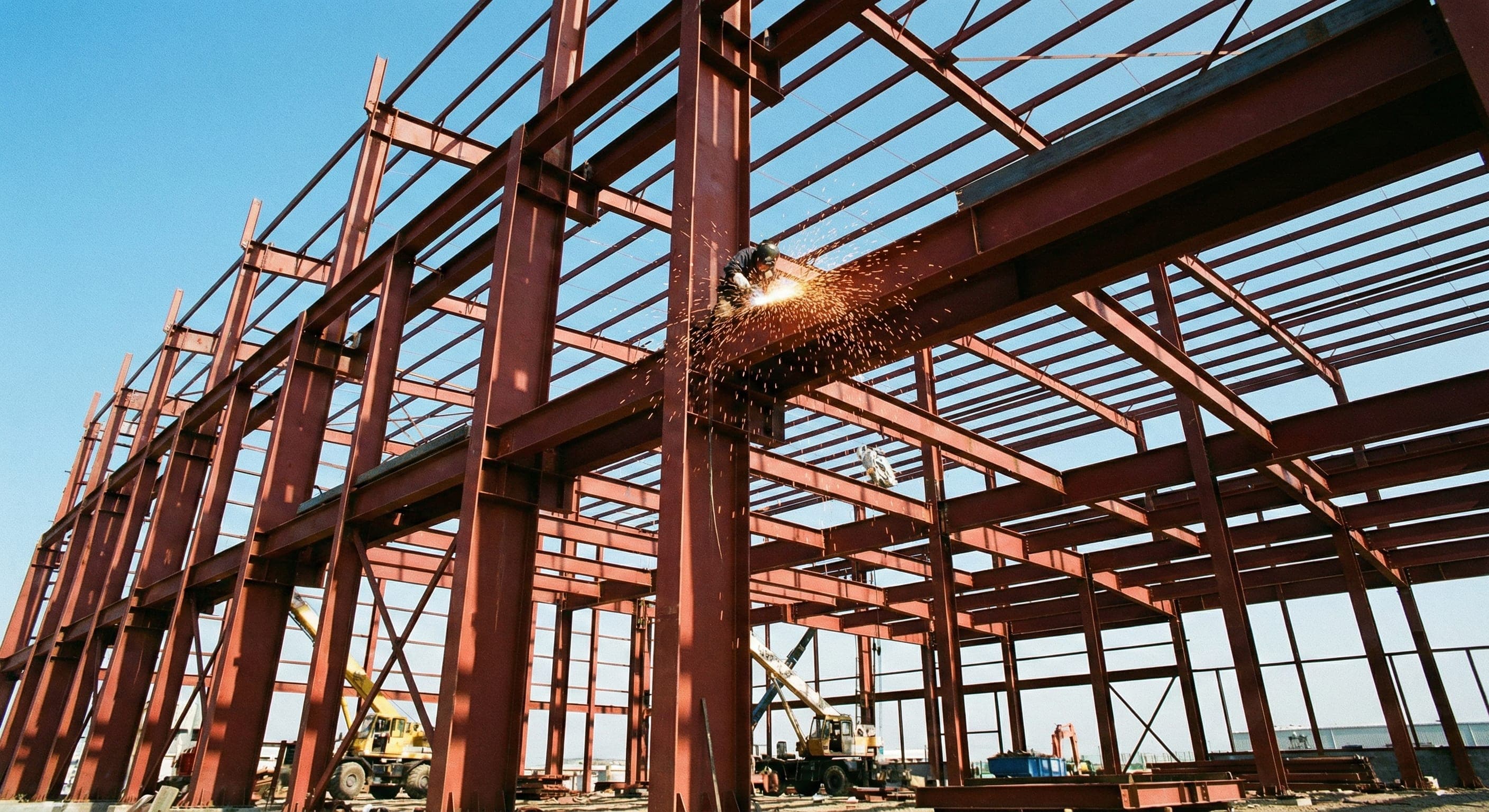
In the Pre-Engineered Building (PEB) sector, the industry standard is shifting rapidly from E250 (Mild Steel) to E350 (High Tensile). Understanding the metallurgy and economics of this shift is crucial for project profitability.
Mechanical Properties Comparison
The "E" in IS 2062 stands for Engineering Steel, and the number represents the Minimum Yield Strength (MPa).
| Property | Grade E250 (Standard) | Grade E350 (High Tensile) | Impact |
|---|---|---|---|
| Yield Strength | 250 MPa | 350 MPa | +40% Load Bearing |
| Tensile Strength (UTS) | 410 MPa | 490 MPa | Higher Safety Factor |
| Elongation (GL=5.65√A) | 23% | 22% | Negligible Loss in Ductility |
The Economics: Why Pay More to Save Money?
Grade E350 typically costs ₹2,000 - ₹3,000 per MT more than E250. However, the structural advantage allows engineers to select lighter sections.
Example Scenario:
A warehouse column designed in E250 requires an ISMB 450 (72.4 kg/m).
The same load in E350 can often be supported by an ISMB 400 (61.6 kg/m).
- Weight Saving: ~15% reduction in total steel tonnage.
- Transport Saving: Fewer trucks needed for the same project square footage.
- Foundation Saving: Lighter superstructure reduces load on concrete footings.
Availability & Sourcing
While E250 is available from all secondary rollers, genuine E350 is primarily produced by integrated mills (SAIL/JSW/AMNS). Secondary market "E350" often fails elongation tests. At J.M. Shah & Co., we stock verifiable SAIL/JSW E350 material specifically for high-rise and PEB applications.