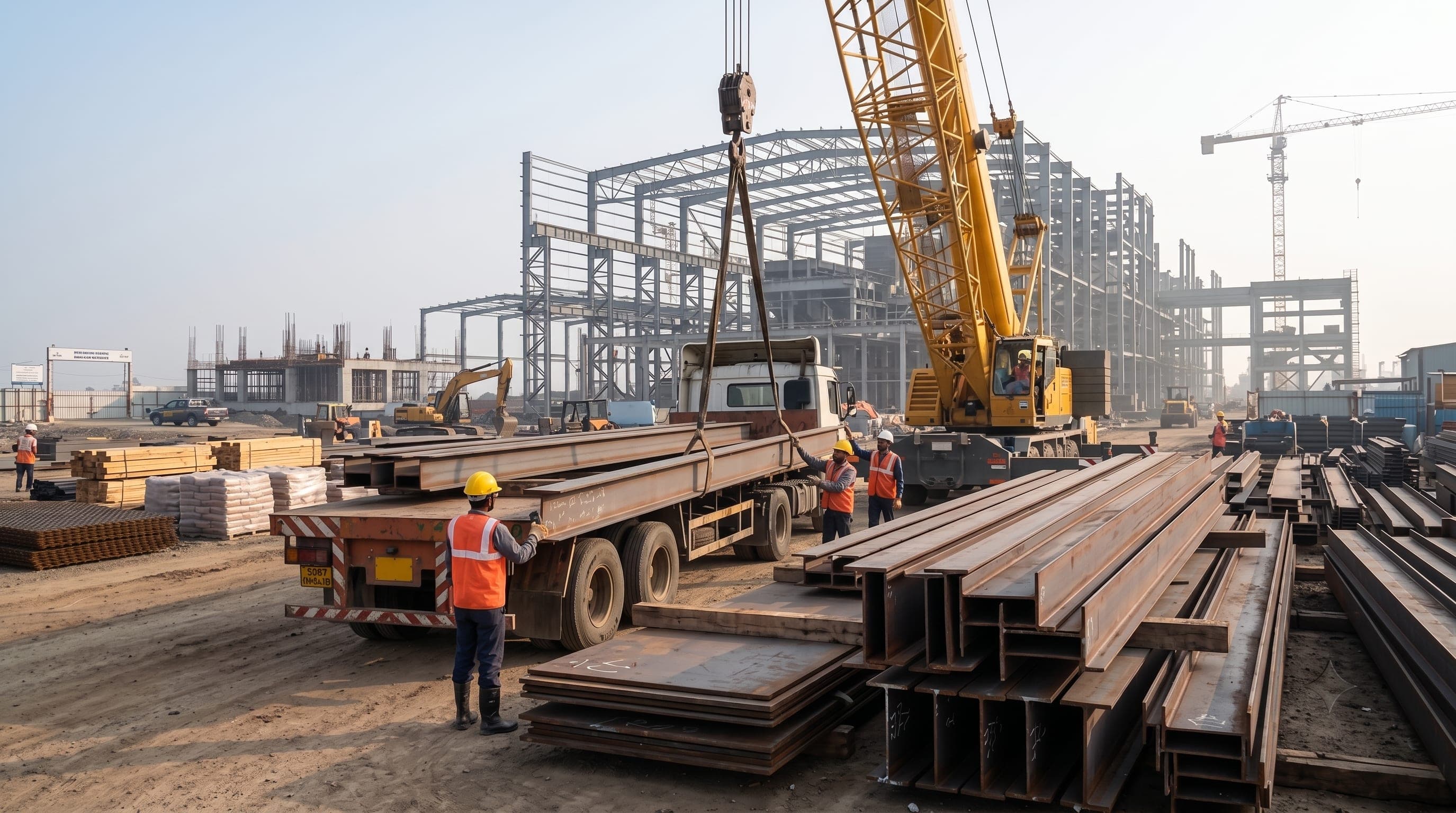
India's steel market has entered September 2026 with a noticeably firmer tone. After the monsoon slowdown, construction and infrastructure activity is beginning to recover, while steel inventories remain lean and raw-material costs are putting renewed pressure on mill pricing.
For an EPC contractor, PEB manufacturer, infrastructure developer or industrial procurement team, the important question is not simply: "Are steel prices going up?"
The more useful question is: "What is driving the market, and how should we change our procurement strategy?"
The latest market data suggests that buyers are entering a period where waiting for a large price correction may carry more risk than it did during the monsoon months. At the same time, rising imports mean that mills may not have unlimited pricing power. For project procurement, that makes the next few weeks particularly important.
India's Steel Market Is Turning Firmer Again
BigMint reported on September 14 that its India steel composite index increased 1.6% week-on-week on September 11, marking the eighth consecutive weekly increase and taking the index to a two-and-a-half-year high.
The move was supported by improving post-monsoon demand, higher raw-material costs, low trader and mill inventories, and continued pricing discipline from steel mills.
The long-steel composite index increased 1.9% week-on-week, while the flat-steel composite index increased 1.2%.
For project buyers, this is significant because the market is no longer being driven by a single factor. Demand, inventories and production costs are moving together.
August 2026 Steel Prices: The Official Numbers
The Ministry of Steel's August 2026 data provides a useful baseline for understanding where the market stood before the latest September movement.
| Product | June 2026 | July 2026 | August 2026 | MoM | YoY |
|---|---|---|---|---|---|
| TMT 10 mm | ₹60,068/t | ₹56,698/t | ₹58,002/t | +2.3% | +5.8% |
| HR Coil 2 mm | ₹70,108/t | ₹69,828/t | ₹70,448/t | +0.9% | +15.5% |
| CR Coil 0.63 mm | ₹77,052/t | ₹76,582/t | ₹76,462/t | -0.2% | +13.3% |
| GP Sheet 0.63 mm | ₹86,505/t | ₹86,415/t | ₹86,668/t | +0.3% | +17.7% |
Source note: Ministry of Steel figures are average prices across Kolkata, Delhi, Mumbai and Chennai and include GST. They are useful market indicators, but should not be treated as project-specific ex-mill or delivered quotations.
What the August Numbers Actually Tell Procurement Teams
The most important number in the table is not necessarily TMT. HR Coil was ₹70,448/tonne in August, 15.5% higher than a year earlier.
GP Sheet was up even more at 17.7% year-on-year, while CR Coil was 13.3% higher. TMT increased 5.8% year-on-year.
This tells us that different steel products are experiencing different levels of price pressure. Procurement teams should therefore avoid using one steel-price headline to estimate the cost of an entire BOQ.
A project consuming structural sections, plates, HRC, pipes and TMT should analyse each major category separately.
September Has Added Another Layer: Tight Spot Availability
BigMint assessed Indian HRC at ₹62,700/tonne ex-Mumbai on September 11 for its 2.5–8 mm IS 2062 Grade E250 benchmark, up ₹700/tonne week-on-week. The assessment excludes GST.
Trade-level BF-route rebar reached ₹59,000/tonne ex-Mumbai on September 11, up ₹1,700/tonne week-on-week.
These benchmarks are not directly comparable with the Ministry of Steel's GST-inclusive metro averages because the methodologies and specifications differ. But together they show the direction of the market: September pricing has strengthened materially from the softer monsoon period.
Why Are Steel Prices Firming?
1. Post-Monsoon Construction Activity
As weather disruptions ease, construction and infrastructure activity is beginning to recover. BigMint reported improved project booking activity and distributor restocking as buyers prepare for stronger seasonal demand.
For EPC companies, this is important because project demand often returns faster than the supply chain can rebuild inventory.
2. Low Inventories
BigMint reported lean inventories across the distribution channel, while mill inventories for some long-steel routes were around six to seven days.
When inventory is low, a buyer may find that the difference between a good quotation and a usable quotation is simply availability.
3. Coking Coal Costs
Reuters reported that Indian steel prices could rise further as coking-coal costs increase and post-monsoon infrastructure and automotive demand recover.
BigMint's premium hard coking coal assessment reached $306/tonne CNF India on September 11, up $7/tonne week-on-week.
Higher input costs create a cost floor beneath finished-steel prices.
4. Mills Are Maintaining Pricing Discipline
Several mills have remained cautious about accepting large forward bookings while market participants expect further price appreciation.
For large projects, this makes early requirement visibility more valuable. A procurement team that can present a clear BOQ, grade mix and delivery schedule has a better basis for negotiating an actual supply programme than a buyer asking only for today's spot price.
But There Is a Ceiling: Rising Imports
The market is not a one-way street.
Ministry of Steel data shows that India imported 3.487 million tonnes of finished steel during April-August 2026, up 29.5% year-on-year. Exports also increased 34.1% to 2.986 million tonnes.
Reuters reported that rising imports, particularly from China, could limit how far domestic mills can push prices.
This creates an important balance: raw-material costs and tight inventories support prices, while imports provide a potential ceiling.
What Should EPC Companies Do Now?
| Project Requirement | Recommended Approach | Why |
|---|---|---|
| 0–30 days | Secure availability and dispatch schedule | Delay risk can exceed small price savings |
| 30–90 days | Start allocation and commercial discussions now | Avoid last-minute spot procurement |
| 90+ days | Monitor market and procure progressively | Avoid unnecessary working-capital lock-up |
Don't Confuse a Low Steel Price With a Low Procurement Cost
Consider a project where waiting saves ₹1,000/tonne on 500 tonnes. The apparent saving is ₹5 lakh.
But if waiting causes fabrication crews to remain idle, cranes to sit unused, transport to be rescheduled or a project milestone to slip, that ₹5 lakh saving may disappear very quickly.
The correct procurement calculation is therefore:
Total Procurement Cost = Material + Freight + Handling + Finance + Inventory + Delay Risk
This is why project procurement should optimise for landed cost and schedule certainty, not simply the lowest basic rate.
What PEB Manufacturers Should Watch
PEB manufacturers are particularly exposed to structural-steel availability because fabrication schedules depend on receiving the correct sections, plates, grades and dimensions in sequence.
A better procurement sequence is:
Approved Drawings → BOQ → Grade Confirmation → Mill Allocation → Inspection → Dispatch → Fabrication
Buying the cheapest available steel first and figuring out the fabrication sequence later is backwards.
The Procurement Checklist for September 2026
- Confirm the exact grade: Do not quote only "IS 2062". Confirm grade, thickness and project specification.
- Check primary-mill requirements: Confirm whether the tender specifies approved makes or domestic manufacturing requirements.
- Verify MTC requirements: Ensure heat/cast traceability is maintained.
- Confirm availability: Ask for a realistic rolling and dispatch schedule.
- Calculate landed cost: Include freight, inspection, handling and payment terms.
- Align dispatch with site readiness: Avoid both stockouts and unnecessary site inventory.
- Plan recurring requirements: Large BOQs should be split into procurement lots tied to the construction schedule.
The Bottom Line for Steel Buyers
September's market does not justify panic buying.
It does justify better procurement planning.
Steel prices are being supported by post-monsoon demand, low inventories, higher coking-coal costs and disciplined mill pricing. At the same time, rising imports could limit the extent of further price increases.
For EPC, infrastructure, PEB and industrial buyers, the practical response is straightforward:
- Plan requirements earlier.
- Secure critical near-term material.
- Compare landed cost, not just base rate.
- Verify mill, grade and MTC requirements.
- Tie steel dispatch to the project schedule.
- Avoid speculative overstocking.
How J.M. Shah & Co. Can Support Project Procurement
Large steel requirements become easier to manage when the BOQ, mill sourcing, documentation and logistics are coordinated as one procurement process.
J.M. Shah & Co. works with project-specific requirements and direct-to-site supply models for steel used across EPC, infrastructure and industrial projects. The company's existing procurement approach includes primary-mill sourcing, MTC traceability and coordinated project logistics.
If your project has an upcoming requirement for structural steel, plates, coils, pipes, bars or other specification-grade material, share the BOQ, grade, quantity and delivery location.
Planning a Major Steel Requirement?
Share your BOQ and project specifications with our procurement team for a project-specific commercial and supply assessment.
Submit Your BOQFrequently Asked Questions
Are steel prices rising in India in September 2026?
Recent market indicators show a firming trend. BigMint reported its India steel composite index rose 1.6% week-on-week on September 11, reaching a two-and-a-half-year high. Its HRC benchmark was ₹62,700/tonne ex-Mumbai on September 11, excluding GST.
What is driving steel prices higher?
The main factors include post-monsoon demand recovery, low inventories, higher coking-coal costs, controlled mill dispatches and stronger project procurement activity.
Should EPC companies buy steel now?
Near-term project requirements should generally be secured based on actual schedule and availability rather than waiting for an uncertain market correction. Longer-term requirements can be procured progressively depending on commercial terms and project visibility.
What was the August 2026 HRC price in India?
The Ministry of Steel reported an August 2026 average of ₹70,448/tonne for 2 mm HR Coil across four metro markets, including GST. This is different from BigMint's ex-Mumbai benchmark methodology and should not be treated as the same quotation.
How should EPC companies manage steel price risk?
Procurement teams should divide requirements according to project timing, secure critical near-term quantities, monitor raw-material and import trends, verify mill availability and compare total landed cost rather than only the quoted material rate.
Sources: Ministry of Steel / Press Information Bureau, BigMint market intelligence, and Reuters reporting published in September 2026.
The August table is directly supported by the Ministry of Steel's September 3 release. The latest September market movement and ₹62,700/t HRC benchmark come from BigMint's September 14 report. Reuters independently reported that higher coking-coal costs and post-monsoon demand are expected to support further price increases, while imports could limit the upside.