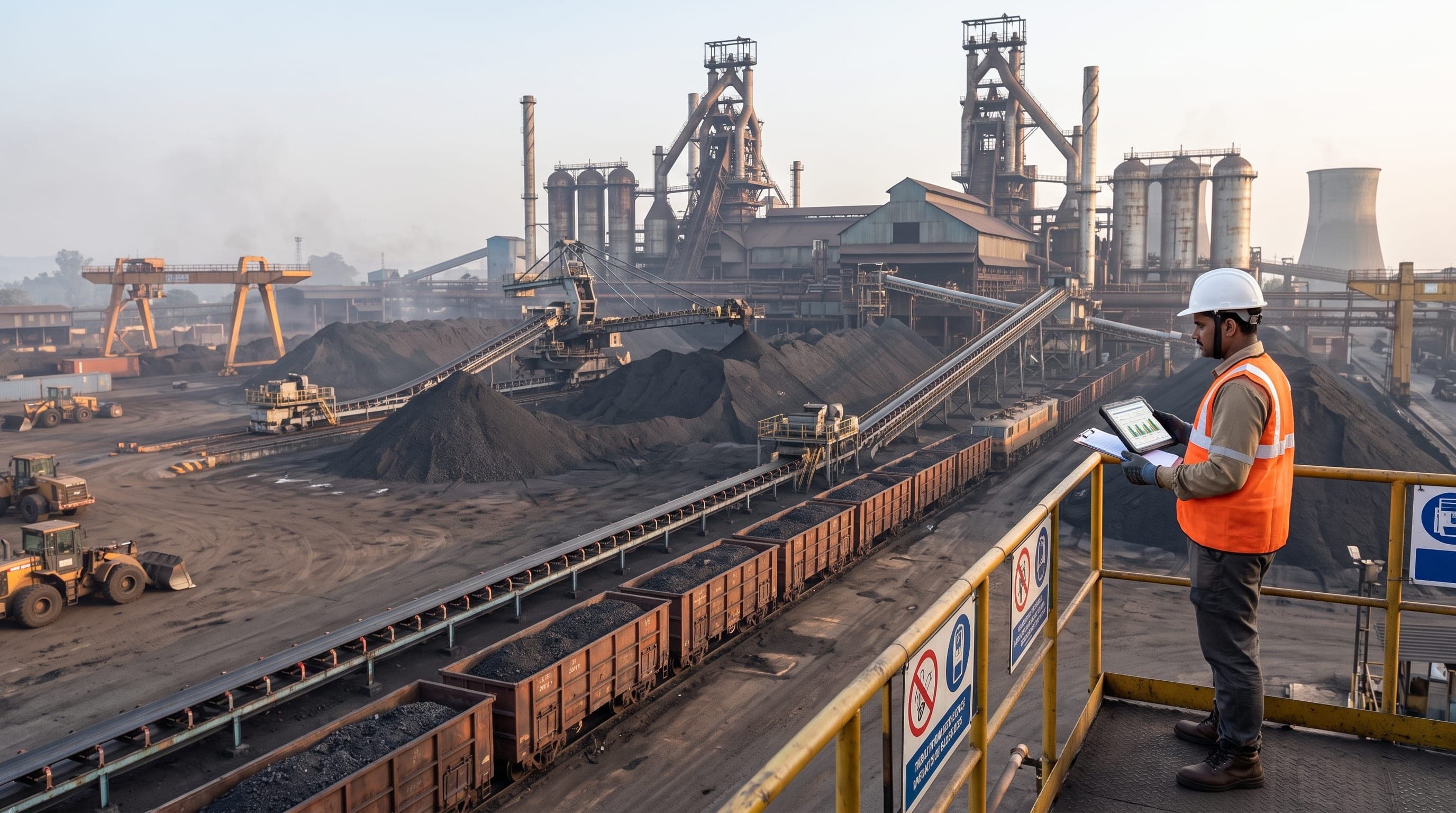
India's steel-cost story is moving beyond finished-steel prices. Beneath every tonne of steel sits a chain of raw materials, including iron ore, coking coal and metallurgical coke, whose availability and pricing can influence mill costs and ultimately the quotations received by project buyers.
A major development this month is the expected surge in metallurgical coke imports. Reuters reported that India's met-coke imports could reach around 6 million tonnes in FY2026-27, approximately 32% higher than the previous year. The increase comes despite the anti-dumping duty imposed in July, with strong demand from pig-iron producers and limited growth in domestic coke production.
For steel procurement teams, the important question is not simply whether met-coke imports are rising. The important question is: what does this tell us about the underlying cost and supply conditions facing Indian steelmakers?
India's Steel Cost Story Is Moving Beyond Finished-Steel Prices
The September steel market has already become firmer following the monsoon period. Finished-steel benchmarks have moved higher as post-monsoon project activity, distributor restocking and raw-material costs influence the market.
The newer development is further upstream. Metallurgical coke is an important input for blast-furnace-based steelmaking and is also used in pig iron, foundries and ferro-alloy production.
When an essential input remains structurally tight, steel buyers should pay attention even if the finished-steel price has not yet fully reflected the pressure.
Met Coke Imports Could Reach a Record 6 Million Tonnes
The latest estimate is significant for India's steel and pig-iron supply chain.
| Indicator | Latest Development |
|---|---|
| FY2026-27 met-coke imports | ~6 million tonnes projected |
| Year-on-year change | ~32% increase |
| Reported major sources | Indonesia and Poland |
| Domestic met-coke production growth | ~6% YoY |
| August domestic met-coke price | ₹35,850/tonne |
| August YoY price change | +24% |
Reuters reported that the projected increase is being driven by strong demand from pig-iron producers and inadequate domestic production growth. The combination is important because it shows that imported material remains relevant to the market even after the introduction of trade protection measures.
Why Are Imports Rising Despite Anti-Dumping Duty?
The answer is not simply that imported material is cheaper. There is a supply-demand issue underneath the numbers.
Domestic met-coke production has not expanded as quickly as requirements from steel and pig-iron producers. As a result, buyers continue to look overseas for material even after the introduction of trade protection.
The current market is therefore being shaped by two forces:
Policy Direction
Trade measures are intended to support domestic production and protect domestic producers.
Industry Requirement
Steel and pig-iron producers still require adequate volumes of metallurgical coke at commercially viable prices.
For steel buyers, the second factor matters enormously because availability and input costs eventually influence the economics of steel production.
The Cost Pressure Is Already Visible
Reuters reported that India's domestic met-coke price reached approximately ₹35,850 per tonne in August 2026, around 24% higher than a year earlier.
That does not mean steel prices will automatically rise by 24%. The relationship between an upstream raw material and the finished product is much more complicated.
Steel Production Cost Chain
Iron Ore + Coking Coal / Met Coke + Energy + Fluxes + Operations + Logistics + Finance
↓
Steel Production Cost → Mill Pricing → Distributor / Project Pricing → Delivered Cost
This is why procurement teams should avoid making a steel-buying decision based on one commodity price in isolation.
What About Iron Ore?
There is another important development in India's raw-material chain. NMDC has said it is targeting 60 million tonnes of iron-ore production in FY2026-27, compared with more than 50 million tonnes in FY2026, as it works to meet growing domestic demand from steelmakers.
NMDC has also outlined a longer-term target of reaching 100 million tonnes of annual iron-ore production by 2030-31. This is relevant because India's steel industry is simultaneously working through a period of expanding domestic steelmaking capacity and demand.
| Raw Material | Current Signal | Why Buyers Should Watch It |
|---|---|---|
| Iron Ore | NMDC targeting higher production | Supports domestic steelmaking raw-material availability |
| Met Coke | Imports projected to rise sharply | Highlights supply and cost pressure upstream |
| Coking Coal | Elevated cost remains relevant | Can influence BF-route steel production economics |
| Finished Steel | Post-monsoon demand remains important | Direct impact on project procurement budgets |
What Does This Mean for Steel Prices?
It would be wrong to say that higher met-coke prices automatically translate into a specific increase in finished-steel prices.
Finished-steel prices also depend on:
- Domestic construction and infrastructure demand
- Automotive and industrial demand
- Finished-steel imports and exports
- Mill utilisation and order books
- Distributor inventory
- Iron ore and coking-coal costs
- Freight and logistics costs
- Government trade measures
- Global steel prices
- Seasonal project activity
The met-coke story therefore adds another layer to the market: the cost floor underneath some steelmaking routes is becoming more important.
The Procurement Implication: Don't Budget Steel With One Number
For large EPC and industrial projects, the more useful question is not simply:
"What is today's steel rate?"
A better procurement question is: "What is our exposure to steel-price movement over the next 30, 60 and 90 days?"
A large project should not necessarily be treated as one procurement event. Requirements can be divided according to project schedule and material consumption.
| Requirement Horizon | Procurement Approach | Main Objective |
|---|---|---|
| 0–30 days | Secure critical quantities | Protect project execution |
| 30–60 days | Confirm commercial terms and availability | Reduce price and lead-time risk |
| 60–90 days | Monitor raw materials and steel benchmarks | Avoid unnecessary early buying |
| 90+ days | Progressive procurement | Protect working capital |
The correct strategy depends on the project, specification and commercial terms, but the principle is straightforward: match procurement timing to project consumption, not to market headlines.
Why Availability Can Matter More Than ₹500 Per Tonne
Consider a fabrication project requiring 500 tonnes of structural steel.
If one supplier offers material at ₹500/tonne less than another supplier, the apparent saving is:
₹500 × 500 tonnes = ₹2.5 lakh
That looks attractive. But if the cheaper material is unavailable for three weeks and the delay affects fabrication, erection, cranes, labour or project milestones, the saving may become irrelevant.
Serious project procurement should therefore compare material + freight + finance + handling + inspection + inventory + delay risk, rather than comparing only the basic steel rate.
What EPC Procurement Teams Should Monitor Now
1. Finished-Steel Benchmarks
Track the products actually relevant to your project instead of relying on a generic "steel price." Depending on the requirement, this can include TMT, HRC, HR plates, structural sections, CRC, GP/GC products and pipes.
2. Coking Coal and Met Coke
For blast-furnace-based steelmaking, changes in the upstream raw-material chain can influence production economics. The latest met-coke import and price data is therefore worth monitoring alongside finished-steel benchmarks.
3. Import Volumes
India's finished-steel imports reached 3.487 million tonnes during April-August 2026, up 29.5% year-on-year, according to Ministry of Steel data. Finished-steel exports during the same period were 2.986 million tonnes, up 34.1%.
Import availability can provide a ceiling to domestic pricing depending on product, origin, trade measures and landed economics.
4. Iron Ore Availability
NMDC's planned increase in iron-ore production is relevant because iron ore remains one of the fundamental inputs for India's steelmaking chain.
5. Project Demand
Post-monsoon infrastructure activity and industrial project execution can rapidly change distributor inventories, mill order books and lead times.
A Practical Steel Procurement Dashboard
For large projects, procurement teams can maintain a simple weekly dashboard covering the indicators below.
| Indicator | What to Watch | Procurement Implication |
|---|---|---|
| TMT / Rebar | Weekly movement | Reinforcement cost exposure |
| HRC / HR Plate | Weekly movement | Plate and fabrication exposure |
| Structural Steel | Availability and mill offers | Fabrication schedule risk |
| Met Coke | Price and availability | Upstream cost pressure |
| Coking Coal | Import benchmark | BF-route cost pressure |
| Iron Ore | Domestic availability | Raw-material supply |
| Imports | Volume and origin | Potential pricing ceiling |
| Mill Inventory | Availability and lead time | Delivery risk |
| Freight | Route-wise cost | Landed-cost movement |
What PEB and Fabrication Companies Should Do
PEB manufacturers and fabricators have a slightly different exposure. Their risk is not only the steel price. It is steel price + section availability + fabrication sequence + delivery timing.
A delayed section can disrupt an entire fabrication batch. Procurement should therefore connect:
Approved Drawings → BOQ → Grade → Section Availability → Mill Allocation → Inspection → Dispatch → Fabrication
The earlier critical sections and plates are identified, the easier it becomes to manage availability risk without unnecessarily carrying the entire project inventory.
Should Companies Buy Steel Immediately?
There is no universal "buy now" answer.
There is, however, a clear distinction between speculation and schedule protection.
- Material required within 30 days: Prioritise confirmed availability and delivery.
- Material required within 30–60 days: Start commercial discussions and secure allocation early where appropriate.
- Material required after 90 days: Avoid blindly stocking the entire requirement. Monitor the market and procure progressively according to project visibility.
This approach can reduce the risk of both overstocking and last-minute buying in a tightening market.
What Could Change the Outlook?
The current cost picture is not guaranteed to move in one direction.
Factors That Could Reduce Pressure
- Higher finished-steel imports
- Weaker domestic construction demand
- Lower coking-coal prices
- Improved domestic met-coke availability
- Lower global steel prices
- Weaker distributor restocking
Factors That Could Increase Pressure
- Stronger infrastructure demand
- Further raw-material cost increases
- Continued met-coke supply constraints
- Lean mill inventories
- Improved export realisations
- Stronger domestic project demand
Procurement teams should therefore monitor the whole steel cost chain rather than trying to predict one finished-steel price.
The Bottom Line for Indian Steel Buyers
The latest met-coke data is not a reason for panic buying. It is a reason to pay more attention to what sits underneath the steel price.
India's met-coke imports are projected to reach a record level despite the anti-dumping duty, while domestic met-coke prices have risen sharply year-on-year. At the same time, NMDC is planning a significant increase in iron-ore production to support growing domestic steel demand.
- Don't rely on one steel-price benchmark.
- Track raw-material costs.
- Separate near-term and long-term requirements.
- Secure critical material before schedule pressure becomes urgent.
- Compare landed cost rather than only the basic rate.
- Confirm grade, specification and mill requirements.
- Maintain MTC and heat-number traceability.
- Align dispatches with actual site consumption.
The cheapest tonne is not necessarily the cheapest tonne for your project. Availability, documentation, freight, financing, quality compliance and delivery timing all contribute to the real landed cost.
How J.M. Shah & Co. Supports Project Steel Procurement
For large steel requirements, procurement becomes more reliable when sourcing, documentation and logistics are managed together.
J.M. Shah & Co. supports project-specific and direct-to-site steel procurement for EPC, infrastructure and industrial requirements, with sourcing across structural steel, plates and sheets, pipes, bars and wires, coils and other specification-grade products.
For project enquiries, buyers can share the BOQ, grade/specification, quantity and delivery location so the requirement can be assessed based on availability, sourcing and delivered-cost considerations.
Planning a Major Steel Requirement?
Share your BOQ and project specifications with the J.M. Shah & Co. procurement team.
sales@jmshahandco.comFrequently Asked Questions
Why are metallurgical coke imports rising in India in 2026?
India's met-coke imports are projected to reach around 6 million tonnes in FY2026-27, about 32% higher than the previous year. Recent reporting attributes the increase to strong demand from pig-iron producers and insufficient domestic production growth.
How do met coke prices affect steel prices in India?
Met coke is an important input for blast-furnace-based steelmaking. Higher met-coke and coking-coal costs can increase production costs, although the final impact on steel prices also depends on demand, imports, iron ore, mill utilisation and other market factors.
What is the reported met coke price in India in 2026?
Reuters reported that domestic met-coke prices reached approximately ₹35,850 per tonne in August 2026, around 24% higher year-on-year.
Will higher met coke prices increase Indian steel prices?
Higher met-coke costs can add upward cost pressure, but they do not automatically determine finished-steel prices. Demand, imports, iron ore, coking coal, mill inventories and global market conditions also influence steel prices.
What should EPC companies monitor when steel prices are volatile?
EPC procurement teams should monitor finished-steel prices, raw-material costs, mill availability, imports, freight, project schedules and inventory levels instead of relying on a single market benchmark.
Is India increasing domestic iron ore production?
NMDC has stated that it is targeting 60 million tonnes of iron-ore production in FY2026-27, compared with more than 50 million tonnes in FY2026.
Sources & Market Data
- Reuters reporting on India's metallurgical coke imports and domestic met-coke prices, September 2026.
- Directorate General of Trade Remedies (DGTR) documentation on metallurgical coke trade measures.
- Ministry of Steel / Government of India data on steel production, consumption and trade.
- NMDC disclosures and reporting on FY2026-27 iron-ore production targets.
- BigMint market benchmarks for Indian steel and raw materials.